Here at esnl, we regard the Ron Cobb as the greatest editorial cartoonist of the 20th Century. We first encountered his unique style a razor-sharp insight in the late Los Angeles Free Press on moving to California in the fall of 1967. If the mark of a great artist is a body or work transcending time and place, he certainly made his mark, as exemplified in the timely offering for nearly 60 years ago:
What if the current, and global, wave of protests of Israel’s slaughter of the innocents in Palestine is a symptom of something deeper, a systemic malaise afflicting the West’s<
Consider the following from Gareth Fearn, a British academic whose research includes a deep focus on the politics of of austerity and the transition to cleaner energy sources, writing in the London Review of Books:
There is a refusal by liberals to accept accountability for the world they have created, through their support for wars in the Middle East, their acceptance of growing inequality and poverty, cuts to public services, glacial action on climate change and failure to create secure and meaningful jobs.
This could be a moment for significant reform, but it would require a challenge to at least some sections of capital. Changing university funding models means taking on Wall Street. Arms companies rely on US defence spending and its military interventions or proxy wars. Action on climate change means losses for fossil fuel companies, whose owners often fund the conservative right.
Liberals in the US and across Europe have decided they do not want to take on this challenge. Their latest wheeze is to de-risk investment in the hope that it will revitalise stagnating economies, while doing what they can to see off any challenge from the more progressive left. That means heavily policing and demonising protests, working with the right to undermine candidates and parties that do seek to challenge capital (and the status of liberal parties), and more generally polluting the political sphere with bullshit to blur the lines of accountability – as when the mayor of New York, Eric Adams, insinuated that the protests at Columbia were instigated by ‘external actors’, or a Princeton administrator allegedly fabricated stories about threats made to staff.
Liberalism has two core components: the protection of property rights and a notion of negative freedom grounded in human rights and political checks and balances. What we are now seeing in the US (and the UK, and elsewhere in Europe) is the defence of the former at the expense of the latter. Political leaders and university managers are undermining not only free expression but the role of the academy in holding political decisions to account. Large sections of the news media are engaged in holding the public to account rather than politicians. And, perhaps most fundamentally, the ballot box offers a choice only between the degree of authoritarianism and economic dysfunction available to voters. If this situation persists, not only in the US but across the world, then occupying a university building will seem like a picnic when compared with what may be coming down the road.
While Donald Trump scoffs at global warming and chants “Drill, baby, drill,” the world’s climate scientists now see catastrophic heat as all but inevitable.
Their despair was captured by an international survey of climatologists conducted by the Guardian:
Hundreds of the world’s leading climate scientists expect global temperatures to rise to at least 2.5C (4.5F) above preindustrial levels this century, blasting past internationally agreed targets and causing catastrophic consequences for humanity and the planet, an exclusive Guardian survey has revealed.
Almost 80% of the respondents, all from the authoritative Intergovernmental Panel on Climate Change (IPCC), foresee at least 2.5C of global heating, while almost half anticipate at least 3C (5.4F). Only 6% thought the internationally agreed 1.5C (2.7F) limit would be met.
Many of the scientists envisage a “semi-dystopian” future, with famines, conflicts and mass migration, driven by heatwaves, wildfires, floods and storms of an intensity and frequency far beyond those that have already struck.
“I think we are headed for major societal disruption within the next five years,” said Gretta Pecl, at the University of Tasmania. “[Authorities] will be overwhelmed by extreme event after extreme event, food production will be disrupted. I could not feel greater despair over the future.”
A sidebar to the report focuses on the concerns of individual scients.Here’s an excerpt:
The capture of politicians and the media by vastly wealthy fossil fuel companies and petrostates, whose oil, gas and coal are the root cause of the climate crisis, was frequently cited. “The economic interests of nations often take precedence,” said Lincoln Alves at Brazil’s National Institute for Space Research.
Stephen Humphreys at the London School of Economics said: “The tacit calculus of decision-makers, particularly in the Anglosphere – US, Canada, UK, Australia – but also Russia and the major fossil fuel producers in the Middle East, is driving us into a world in which the vulnerable will suffer, while the well-heeled will hope to stay safe above the waterline” – even with the cataclysmic 3.5C rise he expects. Asked what individual action would be effective, he said: “Civil disobedience.”
Disinformation was a major concern for scientists from Brazil to Ukraine. This was polarising society, compounding a poor public understanding of climate risk and blinding people to the fact almost all the climate solutions needed were at hand, they said.
“The enormity of the problem is not well understood,” said Ralph Sims, at Massey University in New Zealand. “So there will be environmental refugees by the millions, extreme weather events escalating, food and water shortages, before the majority accept the urgency in reducing emissions – by which time it will be too late.”
Donald Trump says he wants to make America great again.
But what he wants is to make America great again for the plutocratic elite, while stripping the rest of us of any opportunity for the rest of us to live a peaceful, harmonious life of tolerance, free from the avaricious intrusiveness of always-tracking, all-hearing, ever-nudging mind-colonizing apparat of the corporate/state panopticon.
Note the headline omits the “again” part of his slogan, because the world he envisages is that of the county the way it was when he was born, at the very start of the post-World War II Baby Boom generation and before the modern Civil Rights, voting rights, and women’s rights movements caught fire.
It happens that I know that world quite well. Trump was born 16 June 1946, five week before I was born. Two other Presidents were born with weeks of Trump, George W. Bush on 6 July 1946, and William Jefferson Clinton 19 August 1946.
The world we arrived in saw an America at its peak, the world’s only nuclear power [the first Soviet nuke was detonated 25 August 1949] and the only major industrial nation with factories and other infrastructure untouched by the crisis, save for Pearl Harbor and Alaska’s Aleutian islands of Attu and Kiska [yes, there actually was an invasion and occupation of American soil between 11 May 1942 and 19 August 1943, a fact often neglected from American history classes].
My, how things gave changed.
Let’s begin with a look at changes in taxes
In 1946, the richest Americans paid nominal maximum tax rate of 91 percent, enabling the federal government to launch major spending programs of education, infrastructure and other public benefit programs.
Rates remained high throughout the administration of Republican President Dwight D. Eisenhower, and plunged during the Republican Ronald Reagan years,
So what was the net effect of this drive to spare the poor rich? The uber-wealthy, the folks so envied by mere tyros like the Man Who Would Be President Again, are now paying taxes at a lower rate than a school teacher. a janitor, or a cocktail waitress.
Take a look at this, from the New York Times via Common Dreams:
In addition, in the Boomer world in which our three Presidents were raised the U.S. also taxed large inheritances at a healthy rate, a policy now hedged by vastly expanded exemptions:
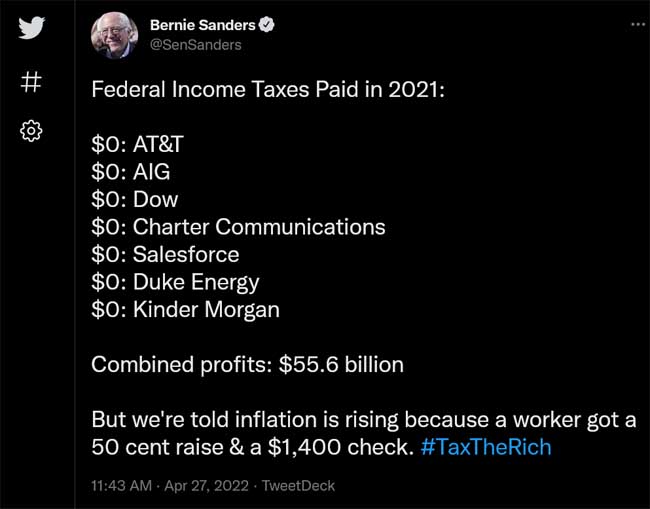
Another major sector experiencing a major fiscal blessing has been the corporation, with taxes on earnings slashed dramatically since those days of the :great America worshipped by Trumpeteers:
The benefits to corporations were predictable:
The net result of all this high stakes tax jiggering is a massive shift in the tax burden from corporations to individuals:
And who has befitted most from all this Congressional largess?
We bet you can guess:
The net impact of cuts and to corresponding CEO pay packets has become so severe that in many cases XCEOs pocket more money than their firms make in profits.
Here are some examples, captured graphically by Inequality.org:
CBS News reported in 2019 that “CEO compensation rose 940% from 1978 to 2018, compared with a 12% rise in pay for the average American worker during the same period, according to the Economic Policy Institute.”
And when in the following year some corporations, acting in part over public outrage over reports of the pay disparity chasm, announce CEO salary cuts, the measures often turned out to be a bit of cosmetic bait-and-switch, as the Institute for Policy Studies noted in a 15 March 2021 analysis: presented to the Senate Budget Committee:
More than 500 publicly held U.S. companies announced cuts to their CEO’s base salary in 2020. These moves garnered considerable positive press coverage, but they had a negligible impact on pay levels since straight salary makes up on average only 10 percent of executive compensation packages.15 Some of the early proxy filings make this clear. A.O. Smith CEO Kevin J. Wheeler, for example, took a 25 percent salary cut while enjoying a 36 percent increase in his overall compensation. At Whirlpool, CEO Mark Bitzer accepted a 25 percent trim on his base salary.
And as the report notes:
We can and must do better, as a nation, than accept a corporate business model that creates prosperity for the few and precarity for the many. And we can’t afford to wait for corporations and their shareholders to solve this problem. Corporate boards have shown us — over a decade ago in the financial crash and over the last year with the pandemic — that we cannot rely on them to do the right thing when it comes to CEO pay.
Most Americans agree, according to an April 2022 SRSS survey of a cross section of the American public which asked “Do you think most CEOs of America’s largest companies are compensated too much, too little, or about the right amount?”
Too much, declared most folks allegiant to both the red and the blue [;And just how the hell did the Grand Old Party become the red party?; Marx must be spinning in his grave.
As federal funding for states shrinks with the impact of tax “reforms,” states and local governments are forced to resort to so-called regressive taxes, such as the sales tax, to make up for the shortfall.
A regressive tax is one exacted at the same rate for all, as opposed to, say, an income tax, where rates increase as earnings in crease. Therefore, the regressive tax hits hardest on the poor, as illustrated in this chart from the Institute on Taxation and Economic Policy:
So let’s make America great for people who aren’t trust fund tycoons, Harvard graduates, and trust fund nepo babies,and start be re-instituting taxes on the wealthiest.
“Yeah, of course the oligarchs run Russia. But guess what? Oligarchs run the United States as well. And it’s not just the United States, it’s not just Russia; Europe, the UK, all over the world, we’re seeing a small number of incredibly wealthy people running things in their favour. A global oligarchy. This is an issue that needs to be talked about.”
Labor leader, radical, Socialist, presidential candidate: Eugene Victor Debs was a homegrown American original. He formed the American Railway Union, led the Pullman strike of the 1890s in which he was jailed and emerged a dedicated Socialist. An idealistic, impassioned fighter for economic and social justice, he was brilliant, eloquent and eminently human. As a “radical” he fought for women’s suffrage, workmen’s compensation, pensions and Social Security all commonplace today. Five times the Socialist candidate for president, his last campaign was run from federal prison where he garnered almost a million votes.
— From his entry in the U.S. Department of Labor’s Hall of Honor
No figure in American history better exemplifies the role socialism once played in American politics than Eugene V. Debs, whose role in the labor movement began with his time as a railroad fireman.
Shoveling tons of coal into the fireboxes of the massive steam engines that moved endless cars caring the raw materials and finished produced of American industry products and raw materials of industry and agriculture and kept people on the move in a vast and growing land.
As a union organizer he learned political skills he would then use to run for office, both as a successful legislative candidate and as presidential candidate, including one run from a prison cell after his incarceration for opposing America’s participation in the First Word War.
But today we focus on a unique work, a critique of America’s first grand film spectacle, D.W. Griffith’s infamous Birth of a Nation.
Griffith’s film, a Southerner’s paen to the “heroic” role of the Ku Klux Klan in defeating the North’s efforts at Reconstruction of the defeated South following the Civil War, is filled with execrable racist tropes and praises the lethal violence deployed against freed slaves attempting to claim their promised equality.
Debs took on the film in a letter to the editor of his hometown paper, the Terre Haute, Indiana, Post, which the editor ran as a standalone article in the paper’s January 1916 edition under the headline “Debs Says Local Elections Bad as Ones in Big Movie”:
The merits of the spectacular drama The Birth of a Nation excite bitter comment whenever it is presented. There is no question that it is a wonderful production, that many of its scenes are tense and thrilling, and that there is much in the play to approve and commend, but if the author’s studied purpose was to insult the black race and to revive and intensify the bitter prejudices which grew out of the war, he could not have better succeeded. It would be passing strange if the colored people did not protest against certain shocking features of the drama as doing them and their race grossest injustice.
If it be absolutely essential to the play to present those harrowing rape scenes, then why not round them out in their historic completeness and show the dissolute sons of the plantation owner ravishing the black daughter before her parents’ eyes?
For every white woman raped in the South by a black fiend, a thousand black women have been seduced and outraged by white gentlemen; but no hint of this is given in the series of pictures composing The Birth of a Nation. It is only the black brute that is guilty according to this and all other stories written about the Negro by Thomas Dixon, the author, who also calls himself a minister of Christ.
Four Million Mulattos
There are four million mulattos in this country, most of whom were born out of wedlock and all of whom have a white father or grandfather, and these white gentlemen are ready to fight at the drop of the hat for “white supremacy” and against “nigger equality.”
The pretended reverence for Lincoln in the play does not at all square with the facts of history. Lincoln was hated with a savage hate by the slaveowners of the South and it was this ferocious hate that culminated in his assassination. The reverence now shown him on the stage is a convenient mask behind which the same blind hate may vent itself upon the unoffending Negro.
Let it not be overlooked that all our histories have been written by white men and that Negroes had no hand in them. They simply had to take what was given them, but even at that there is no denying the fact that from the time the Negroes were first stolen from their native land by white slave-traders, whom it would be flattery to call brutes, until the last law disfranchising them in the South was put into effect and the last “Jim Crow” car put into commission to attest their standing as livestock, the whole history of the treatment of the Negro race is one of shameless exploitation and degradation, for which the white race can never atone in time nor eternity.
If the black people today could tell their story about The Birth of a Nation, it would be replete with scenes infinitely more cruel and damning than those based upon Dixon’s novel and flashed upon the screen to conceal the white man’s crimes behind the Negro’s misfortune.
Klan Glorified
The Ku Klux Klan are glorified in these pictures as spotless knights, the personification of chivalry and honor, and the audience applauds madly as they dash to the rescue of some imaginary white victim of a black fiend, but care is taken not to portray any of the outrages perpetrated upon defenseless, unoffending Negroes by these same lawless nightriders.
The pictures showing the scenes about the polling places of election day, under Negro domination, are especially calculated to subject the Negro to ridicule and contempt, and the white audience never fails to attest its appreciation by its sneers and cheers.
It’s true such election scenes with their black sluggers and their sodden corruption are disgraceful and revolting, but how much more disgraceful and revolting are they than the election scenes which have occurred in and about Terre Haute during the last few years — scenes in which the sluggers were white, instead of black, and insulted white ladies instead of black wenches; scenes unspeakably low and vile as everyone will admit who bore witness to them? How would it do to make pictures of some of these and travel through the South with them, flashing them upon a screen to show the Negroes in that section what an eminently respectable thing an election is when dominated by white men and by what pure and incorruptible methods the will of the people is expressed in a civilized white community?
Whites Also to Blame
If the white race has demonstrated its “superiority” in any one thing, it is in its politics and elections, and if Negroes should be disfranchised, the evident purpose of Dixon’s pictures, because of their disgraceful conduct at the tolls, then by the same token white men should also be stripped of the ballot and driven from the polling places.
The cheap commercial statistics exhibited at the close of the play to show the progress made by the Negro race is but a weak attempt to excuse the wanton insults heaped upon that race. Intelligent Negroes will not be deceived. The progress they have made is mainly due to themselves. They owe little to the white race as a whole, save their exploitation and degradation.
Let the colored people learn how to depend upon themselves, how to do for themselves, and to win their own way in the world. When they cut loose from the grafting politicians that use them as pawns in the political game and reward one of their number with a spittoon cleaning job in recognition of their race, and stand together; when they begin in earnest to educate themselves and to develop their minds and do their own thinking, they will then command the respect of the white race and of the world, but not before.
Debs’ essay attracted the attention of another remarkable figure, one of the first and perhaps the greatest of America’s early black journalists, Ida B Wells, whose heroic efforts to document lynchings of black Americans remain an iconic chapter in the history of the American press:
Born into slavery, Wells knew first-hand the viciousness of racism, and the terrorism employed to prevent black Americans from their aspirations for equality under the law.
For more on Debs, here’s a little documentary created in 1979 by another socialist who would later make runs at the White House, Sen. Bernie Sanders:
Having assumed complacently after the collapse of the Soviet Union that the threat of totalitarianism had become unthinkable, especially with the spread of economic and cultural globalism, the liberal West is now facing a decline, and even possibly a collapse, in confidence in parliamentary democracy. The heroic resistance of Ukraine is perhaps the only hope that we will recognize in time the dangers of the general slide towards authoritarianism in an increasingly Manichaean world – that is to say, a new dualism of two power blocs confronting each other: one with a free and liberal stance, and one without.
Swiss psychiatrist and disillusioned Freudian Carl Gustav Jung, pondering how people often turn their backs on ideals once espoused to become the opposite of their previous aspirations, coined a term for the phenomenon: Enantidromia, which he defined as “the emergence of the unconscious opposite in the course of time.”
Throughout the first half of the 20th Century, no two ideologies were more violently opposed than internationalist communism and ultranationalist fascism, accounting for at least 30 million Soviet and Nazi German deaths in World War II alone.
Given those massive losses, it would be hard to predict that as of today, the country that spilled so much blood destroying the fascist Nazi empire would become today’s embodiment of the very evil they once shed oceans of blood to destroy.
But today, in a Russia headed by a man who once served in the anti-fascist organs of state security, fascism has emerged yet again, embodied in its President, ex-KGB officer Vladimir Putin.
Just call it a textbook case of entantidromia,
Alexander Motyl, Professor of Political Science at Rutgers University and a New York native born to Ukrainian immigrants, makes the diagnosis in this essay from The Conversation. an plain language academic journal published under a Creative Commons license:
Yes, Putin and Russia are fascist – a political scientist shows how they meet the textbook definition
When Vladimir Putin unleashed an unprovoked invasion of Ukraine on Feb. 24, 2022, the Ukrainian media, public and policymakers almost unanimously began calling the Russian president and the state he leads “rashyst.” The term is a hybrid of a derogatory moniker for Russia – “rasha” – and “fascist.”
Ukrainians did so for two reasons. First, they were countering Putin’s absurd insistence that the Ukrainian authorities – including Ukraine’s Jewish president, Volodymyr Zelenskyy – were Nazis and that Ukraine needed to be “de-Nazified.” Since Ukraine’s tiny number of right-wing extremists are about as influential as the Proud Boys in the United States, what Putin really had in mind was Ukrainians with a distinct Ukrainian identity. De-Nazification thus meant de-Ukrainianization.
Second, Ukrainians were drawing attention to those features of Putin’s Russia that indicated that it was fascist and thus in need of “de-Nazification.” Putin’s Russia was aggressive, anti-democratic and enamored of Putin himself. Unsurprisingly, his Russia’s resemblance to the regimes built by Mussolini and Hitler had not gone unnoticed by Russian and Western analysts in the last decade or so.
Few policymakers, scholars and journalists listened, however, as the term fascism struck many as too vague, too political or too loaded to serve as an accurate description of any repressive regime. Having written about Putin’s Russia as quasi- or proto-fascist already in the mid-2000s, I know from personal experience that few took my claims seriously, often arguing tautologically that Putin had constructed a “Putinist” system.
But, first, a brief foray into the classification schemes that social scientists like to use, which most people find incomprehensible.
Classifications are essential for good social science, because they enable scholars to group political systems according to their shared features and to explore what makes them tick. Aristotle was one of the first to divide systems into those ruled by one, those ruled by a few and those ruled by many.
Authoritarian states rest on the state bureaucracy, military and secret police; they usually circumscribe most of the features of democracies; and they typically are led by juntas, generals or politicians who avoid the limelight.
Totalitarian states abolish all the features of democracy, empower their bureaucracies, militaries and secret police to control all of public and private space, promote all-encompassing ideologies and always have a supreme leader.
War is worshipped and justified by the state’s mendacious propaganda machine. As the brutal invasion of Ukraine shows, war is also practiced, especially if it is directed against a people whose very existence Putin regards as a threat to himself and to Russia.
Finally, fascist states are prone to wars, because members of the secret police and generals, whose raison d’etre is violence, are overrepresented in the ruling elite. In addition, the ideology glorifies war and violence, and a militarist fervor helps to legitimate the supreme leader and reinforce his charisma.
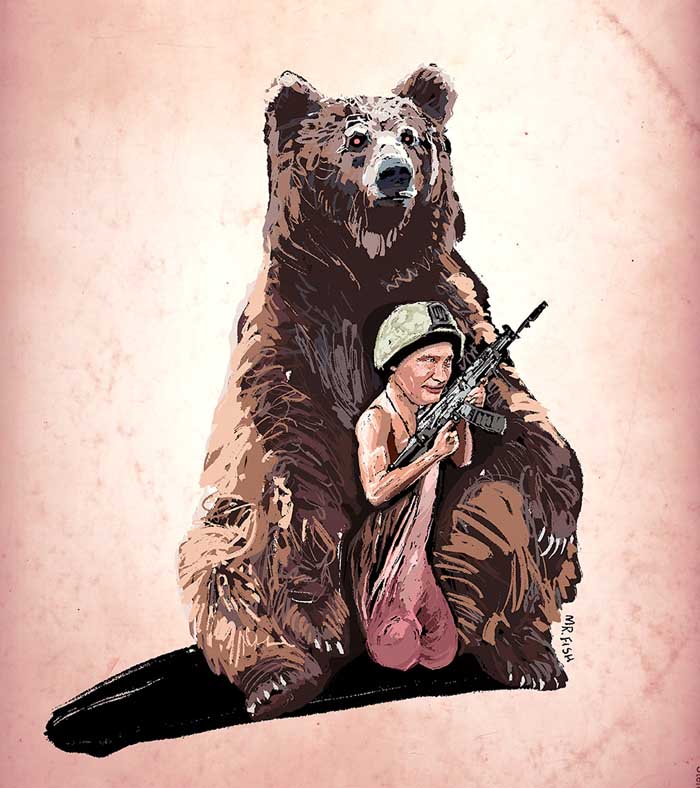
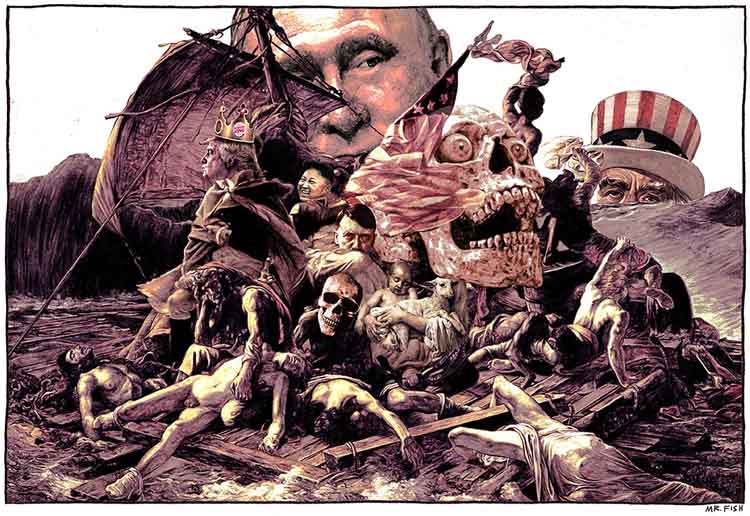
From the World’s Greatest Living Editorial Cartoonist, via Clowncrack:
Here at esnl, we’re very partial to cartoons which play on famous works of art, and Fish’s creation is a timely and topical take of The Raft of the Medusa, a massive 1819 creation by French artist Théodore Géricault.
Completed when the artist was 27, the work has become an icon of French Romanticism. At 491 by 716 cm (16 ft 1 in by 23 ft 6 in), it is an over-life-size painting that depicts a moment from the aftermath of the wreck of the French naval frigate Méduse, which ran aground off the coast of today’s Mauritania on 2 July 1816. On 5 July 1816, at least 147 people were set adrift on a hurriedly constructed raft; all but 15 died in the 13 days before their rescue, and those who survived endured starvation and dehydration and practiced cannibalism (the custom of the sea). The event became an international scandal, in part because its cause was widely attributed to the incompetence of the French captain.
Fish’s take is simply brilliant, capturing the sheer horror of today’s headlines and placing it in historical context [note Hitler, who also invaded Ukraine, Burger King Trump, Putin’s foremost American facilitator, and the grinning visage of Mao Tse Tung, the founder of modern China, the nation emerging as the one clear winner of the Ukrainian invasion.
It is. perhaps, the best single summation of what historians see as the long 20th Century, which began with the horrors of World War I and culminated in Trump’s election.
From Deutsche Welle, military/industrial opportunism at work:
Pointing to Ukraine war, arms lobby pushes for ‘sustainable’ label
Weapons have played a key role in helping Ukraine defend itself against Russia’s invading forces. Now the arms lobby is pushing for investors and EU regulators to classify the industry as “sustainable.”
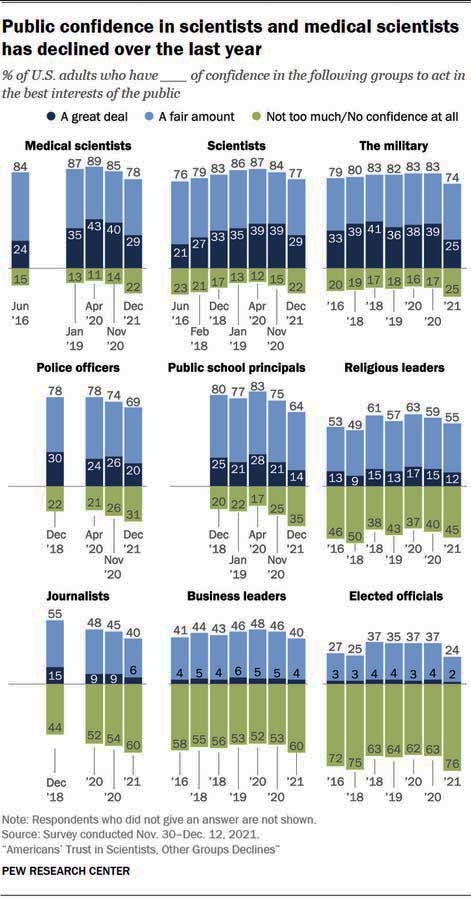
With the third year of the COVID pandemic well underway and as the second year of the Biden administration commences, Americans are becoming less trusting of traditional authority figures, a new survey from the Pew Research Center.
Trust of scientists and the military remains relatively high, although core support for the military drop the most sharply of all groups, while confidence in journalists, business executives, and politicians nears rock bottom.
Americans’ confidence in groups and institutions has turned downward compared with just a year ago. Trust in scientists and medical scientists, once seemingly buoyed by their central role in addressing the coronavirus outbreak, is now below pre-pandemic levels.
Overall, 29% of U.S. adults say they have a great deal of confidence in medical scientists to act in the best interests of the public, down from 40% who said this in November 2020. Similarly, the share with a great deal of confidence in scientists to act in the public’s best interests is down by 10 percentage points (from 39% to 29%), according to a new Pew Research Center survey.
The new findings represent a shift in the recent trajectory of attitudes toward medical scientists and scientists. Public confidence in both groups had increased shortly after the start of the coronavirus outbreak, according to an April 2020 survey. Current ratings of medical scientists and scientists have now fallen below where they were in January 2019, before the emergence of the coronavirus.
Scientists and medical scientists are not the only groups and institutions to see their confidence ratings decline in the last year. The share of Americans who say they have a great deal of confidence in the military to act in the public’s best interests has fallen 14 points, from 39% in November 2020 to 25% in the current survey. And the shares of Americans with a great deal of confidence in K-12 public school principals and police officers have also decreased (by 7 and 6 points, respectively).
Large majorities of Americans continue to have at least a fair amount of confidence in medical scientists (78%) and scientists (77%) to act in the public’s best interests. These ratings place them at the top of the list of nine groups and institutions included in the survey. A large majority of Americans (74%) also express at least a fair amount of confidence in the military to act in the public’s best interests. Roughly two-thirds say this about police officers (69%) and K-12 public school principals (64%), while 55% have at least a fair amount of confidence in religious leaders.
The public continues to express lower levels of confidence in journalists, business leaders and elected officials, though even for these groups, public confidence is tilting more negative. Four-in-ten say they have a great deal or a fair amount of confidence in journalists and business leaders to act in the public’s best interests; six-in-ten now say they have not too much or no confidence at all in these groups. Ratings for elected officials are especially negative: 24% say they have a great deal or fair amount of confidence in elected officials, compared with 76% who say they have not too much or no confidence in them.
With trust in leading institutional leaders plunging, it’s no wonder that populism flourishes. . .
Back in the early 1960s I spent three teenage summers in an intimate relationship with 2,4-Dichlorophenoxyacetic acid. more commonly known as 2,4-D.
Employed by the corporation own a system of irrigation canals in two Northern Colorado counties, my job consisted of sitting on the bumpers of tanker trucks traveling easement roads along canals, hose and spray nozzle in hand, dousing Canadian Thistles with chemical to prevent the plants from flowering and spreading their pesky airborne seeds into the waters of the canals and thence on to farmers’ fields, where they crowd out crops of wheat, maize, and sugar beets.
I and another teenager who held the other hose were assured the chemical was harmless to humans, often sprayed each other to cool off during the frequent hot days of July and August.
2,4D gradually faded from the picture after American agroindustrial giant Monsanto delivered a new weed-killer, Roundup, along with seeds genetically engineered to resist the herbicidal properties of glyphosate, the patented active ingredient in the concoction.
The one-two combination of a potent new weed killer and corporate-owned seeds designed to protect crops from the chemical’s otherwise lethal onslaught made Monsanto king on Big Ag globally [the company was sold to German chemical giant Bayer in 2018].
But resistance to Monsanto’s purported panacea, a combination of concerns over the company’s insistence on barring farmers from using seeds from their harvest to plant next years crops and a forced sale of crops only to dealers authorized by the company along with a growing numbers of research papers challenging the chemical’s safety [which we have covered extensively] has led to a resurgence of that old standby 2.4-D, along with new GMO crops designed to resist it.
But a new study just published raises serious questions about the safety of 2,4-D and the revelation that the bodies of a third of Americans now harbor significant amounts of the chemical, with the most troublesome levels found in the bodies of children and women and child-bearing age.
One out of three people in a large survey showed signs of exposure to a pesticide called 2,4-D, according to a study published today by researchers at the George Washington University. This novel research found that human exposure to this chemical has been rising as agricultural use of the chemical has increased, a finding that raises worries about possible health implications.
“Our study suggests human exposures to 2,4-D have gone up significantly and they are predicted to rise even more in the future,” Marlaina Freisthler, a PhD student and researcher at the George Washington University, said. “These findings raise concerns with regard to whether this heavily used weed-killer might cause health problems, especially for young children who are very sensitive to chemical exposures.”
Lead author Freisthler and her colleagues looked for biomarkers of the pesticide found in urine samples from participants in the National Health and Nutrition Examination Survey. They estimated agricultural use of 2,-D by studying public and private pesticide use data from 2001 until 2014.
Out of 14,395 participants in the survey nearly 33 percent had detectable levels of 2,4-D in their urine. The researchers found that participants with urine levels of this pesticide went from a low of 17 percent at the start of the study in 2001-2002 to a high of nearly 40 percent ten years later.
Other key findings of the new study:
▪ As the use of the herbicide increased during the study period so did human exposures.
▪ Children ages 6-11 had more than double the risk of increasing exposure to 2,4-D.
▪ In addition, women of childbearing age had nearly twice the risk of increased exposure compared to men in the same age group.
▪ Human exposures are likely to rise even more in the near future as this herbicide’s use continues to go up.
2,4-D was developed in the 1940s and soon became a popular weed-killer for farmers who wanted to increase crop yields. In addition, homeowners looking for a pristine, green lawn also turned to 2,4-D often in combination with other lawn chemicals.
Exposure to high levels of this chemical has been linked to cancer, reproductive problems, and other health issues. While scientists don’t know what the impact of exposure to lower levels of the herbicide might be, they do know that 2,4-D is an endocrine disruptor and this study shows children and women of childbearing age are at higher risk of exposure.
Children can be exposed if they play barefoot on a lawn treated with the weed-killer or if they put their hands in their mouths after playing outside, where the soil or grass might be contaminated with the chemical. People also can be exposed by eating soybean-based foods and through inhalation. The now widespread use of 2,4-D on GMO soybeans and cotton leads to more 2,4-D moving in the air, which can expose more people to this chemical, according to the researchers.
“Further study must determine how rising exposure to 2,4-D affects human health–especially when exposure occurs early in life,” Melissa Perry, a professor of environmental and occupational health and senior author of the paper, said. “In addition to exposure to this pesticide, children and other vulnerable groups are also increasingly exposed to other pesticides and these chemicals may act synergistically to produce health problems.”
Consumers who want to avoid exposures to pesticide can purchase organically grown food, which is less likely to be grown with weed killers. They can also avoid using 2,4-D or other pesticides on their lawn or garden, the researchers said.
Meanwhile, Roundup faces an uncertain fate in Europe, where its use is authorized only until 15 December, pending a further review of the compound’s safety.
And there are signs of troubles ahead, as the Guardian reported 26 November:
Only two out of a group of 11 industry studies given to European regulators in support of the re-approval of the main ingredient in Roundup herbicide are scientifically “reliable”, according to a new analysis of corporate-backed studies on the chemical glyphosate.
<snip>
In a report released on Friday, researchers from the Institute of Cancer Research at the Medical University of Vienna in Austria said their review of a set of safety studies submitted to EU regulators by Bayer AG and a coalition of other chemical companies showed that the vast majority do not meet current international standards for scientific validity.
While two of the corporate studies were considered reliable, six were considered partly reliable and three were not reliable, according to the report.
And as for 2,4-D, it was the one of two primary ingredients in Agent Orange, the notorious compound sprayed over much of South Vietnam to kill crops and the trees used by Viet Cong troops to hide from American air strikes during what folks there now call the American War.
One ailment conclusively linked to Agent Orange exposure is bladder cancer, a malady for which we underwent a surgical removal seven years ago, We can’t but wonder if that affliction stemmed from those cooling spays on hot summer days under the Colorado sun decades before.
From Canadian journalist Andrew Nikiforuk, writing on the trucking chaos north of the border for The Tyee, in which he also reveals that much of the funding for the protest hails from the U.S. side of the border:
Welcome to the mining republic of Canada where dysfunction and disinformation accumulate daily like waste in a leaky, toxic tailing pond.
Over the last two weeks Canadians have not only been served a master class on the dismal quality of our political leadership but a pointed lecture on how to destabilize a democracy.
It is clear now that a highly organized group of militants — some with military and counterinsurgency experience — have mobilized incoherent popular frustrations created by the pandemic to shield their goal of undermining a democracy and overthrowing a government they don’t like. Many of these militants hail from Alberta and the west.
The protesters talk about individual rights and freedoms but no one talks about responsibilities and that’s how democracies fail.
They are aided by the internet, foreign funds and perhaps foreign players (the whole “freedom convoy” movement has the stink of covert Russian involvement). As they occupied Ottawa, they presented a hard face composed of a phalanx of diesel trucks and a soft face made up of rock music, fireworks, kids and hot tubs.
Nearly six in 10 Americans, 58%, are dissatisfied with the level of immigration into the U.S. today, while 34% are satisfied. This marks an eight-percentage-point increase in dissatisfaction since last year and a return to the 2019-2020 range.
The 58% dissatisfied includes 35% of all Americans who would prefer that immigration be decreased, 9% increased, and 14% who want levels kept the same. Last year, those dissatisfied were about equally as likely to favor an increase as a decrease, but now the predominant view among the dissatisfied is for less immigration. The proportion who want less immigration has nearly doubled from 19% in 2021 and is well above where it was in 2019 (23%) and 2020 (25%). At the same time, calls for more immigration into the country have dropped.
During our decades of work in community journalism, much of our work focused on the role of developers in the political realm.
One thing a reporter quickly learns is that people who develop real estate for profit exploit the dreams of politicians and buyers to cloak their own dreams of wealth to win approval of their projects. [That real estate developers are also the leading contributors to election campaigns also plays a significant role.]
The same is true when it comes to selling their complete developments.
And at a time when anxieties about climate change and environment degradation reign, what better way to sell developments to the rich that by enshrouding them with a mantle of green?
Consider the following from the Dutch Public Broadcasting service VPRO:
Program notes:
Climate change warnings are leading to large investments in conservation and wildlife management in Africa. But the ambition to guard nature and animals increases social inequality and creates green apartheid.
Bram Vermeulen is in Hoedspruit. This small town on the edge of South Africa’s Kruger Park has been transformed in a short time into a five-star resort, full of restaurants, souvenir shops and real estate agents selling a big promise. For relatively little money you can buy land and luxury villas here, amidst nature and wildlife. A paradise for those who can afford it. But what lies behind this green dream?
A Dutch entrepreneur is among the property developers marketing the ‘Out Of Africa dream’, particularly to Dutch buyers.
An African farmer breeds the animals needed to fill the game parks for hunting and pleasure; from rhinos to sable antelopes. And a militarized anti-poaching unit guards the green paradise we all want so badly.
But on the edges of the town, things are brewing. The staff who work at the resorts are tucked away in a slum. And there appear to be land claims on the land where the private game parks and resorts are springing up.
Thousands of black South Africans are demanding back the land they were driven from during apartheid. The land on which the Dutch entrepreneur is building is also being claimed.
Meanwhile, the private anti-poaching unit that guards the parks and resorts is embroiled in a war with crime syndicates that want to sell the horns of killed rhinos to the Far East for a lot of money.
At 400 square miles in area, the Columbia Glacier of southeastern Alaska is one of great wonders of nature, a mass of blue ice emptying into the waters of Prince William Sound.
But the glacier is vanishing, and the cause is clear, as a study from Oregon State University has determined:
Anthropogenic forcing was sufficient to trigger the recent retreat of Columbia Glacier from its extended position of the past [9,000 years], consistent with our data-driven assessment of the relationship between regional climate change and glacier extent. We conclude that the recent retreat of Columbia Glacier is a response to climate change rather than part of a natural internal tidewater-glacier oscillation.
And now, via NASA’s Earth Observatory, comes dramatic visual evidence of global warming in action:
Located in southeastern Alaska, the Columbia Glacier descends from the flanks of the Chugach Mountains and flows into a narrow inlet connected to Prince William Sound.
Prior to 1980, the glacier was generally stable. This photo from 1957 shows it reaching all the way to Heather Island.
It held a similar position in this aerial photo shot in 1969.
But in 1980, the glacier began to retreat, likely triggered by climate change. It became one of the fastest shrinking glaciers in the world.
Satellite images from the long-running Landsat program have documented the retreat.
This natural-color image shows the glacier as your eyes would see it.
But false-color images can help differentiate between snow and ice, open water, vegetation and exposed bedrock, and rocky debris on the glacier’s surface.
This series of false-color images, acquired over the span of 35 years, shows the glacier’s dramatic retreat as well as some key moments along the way.
1986: Six years into Columbia’s retreat, the glacier had withdrawn more than a mile from Heather Island.
1989: At this point, the glacier still had three branches: the West Branch, Main Branch, and a sliver of ice that flowed east of Great Nunatak Peak.
1995: In some years, patches of lighter colored ice float south of the glacier. This mixture, or “mélange,” consists of sea ice mixed with icebergs that have broken from the glacier.
1997: Notice the medial moraine—a line of debris deposited along the ice surface that shows where separate channels of ice merged.
2000: As Columbia Glacier thinned, rings of freshly exposed rock, known as trimlines, became prominent around the inlet.
2001-2006: The retreat stalled until 2006, when the glacier became constricted by peaks on either side of the channel.
2008: Then, as the glacier’s front retreated into deeper water, it began to float.
2009: As a result, larger chunks of ice started to break off.
2011: By 2011, Columbia’s West and Main branches had split. Icebergs now calved from two distinct fronts.
2013: The West Branch took a large step backward in 2013, surprising scientists who thought it had stabilized.
2014: The Main Branch became increasingly unstable when thinning caused the glacier to lose traction with the floor of the inlet.
2019: Amid a hot summer, the West Branch appeared close to the limit of its retreat.
2021: Continuing to crumble away, the Main Branch in 2021 had retreated about 15 miles from its initial position.
While climate change likely started the retreat, mechanical processes kept the disintegration going.
Tidewater glaciers tend to cycle between periods of slow advance and rapid retreat. What Columbia Glacier will do next remains to be seen.
These dramatic images, coupled with today’s earlier post of the massive drought now afflicting the American Southwest, should, in a rational world, provide yet more conclusive evidence that the need for action to stem our fossil fuel addiction is long past due.








 eats shoots 'n leaves